
Why Leading Through Layers Is Hard: A Small Nonprofit Case
When I am explaining leading through layers, people usually understand what this means in the day-to-day.
One of the reasons I’m so passionate about helping leaders with this though, is because of the ripple effects challenges leading through layers can have over the medium or long term.
Let's use a simple fictional example--a small nonprofit with 8 employees that supports veterans.
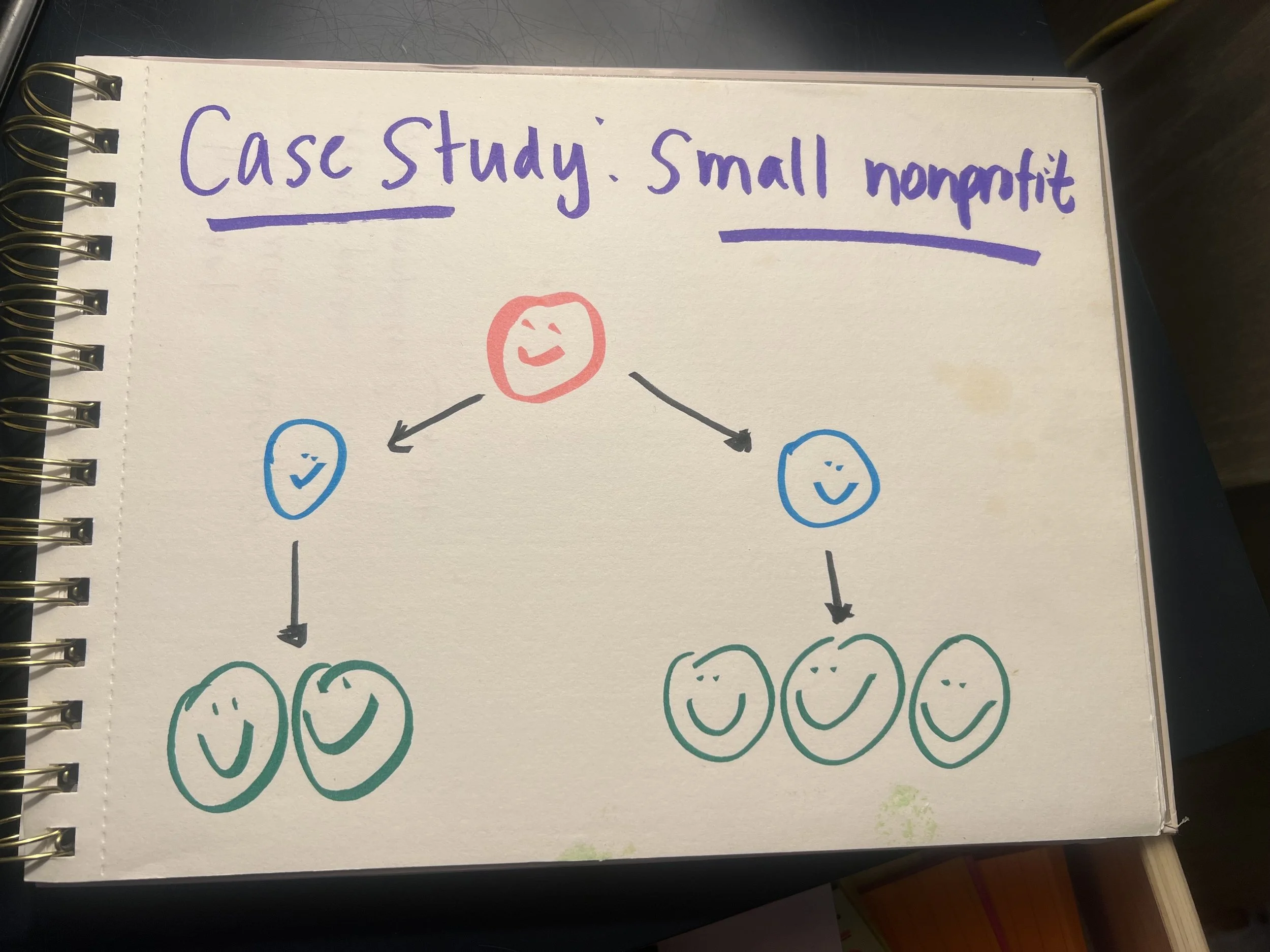
Here’s what the org chart at this fictional nonprofit would look like
There's an Executive Director (the pink smiley face), who has 2 direct reports--the Director of Programs and the Director of Development (the blue smiley faces).
The Director of Development has a team of two: a Development Associate and an Events Manager. (the green smiley faces)
The Director of Programs has a Mental Health Coordinator, a Career Counselor and a Community Engagement Coordinator. (the green smiley faces)
This organization makes a lot of sense--it allows small teams to work together on shared areas of responsibility, it prevents everyone from being involved in every decision and every manager has 2-3 direct reports, which allows for flourishing and developing more easily.
This org structure allows them to serve more veterans, which is, after all, the entire point of the organization!
In this case, the Executive Director leads through layers--they are responsible for the results of people who do not directly work for them.
Lately, this Executive Director has been waking up in a cold sweat in the middle of the night, thinking about the way their last two fundraising events have fallen flat--taking an enormous amount of time and energy and barely yielding an ROI.
The Board has been vocal about their discontent. One of the organization's largest donors was heard saying "This is the last time I go to one of these" as they left the last event. For weeks before and after the last event, staff missed important goals and metrics, often citing the responsibilities of the event as interfering with their other duties.
What really frustrates the Executive Director is that there is so much knowledge on their team about what to do--after all, a few years ago, they had the most amazing event ever. The current Director of Development was actually the Events Manager then--so they know how to do this! The knowledge and experience is there. Why is this happening?
At this point, the leader has a few possible things that can happen–sometimes all three, in order.
Don't get involved--tell the Director of Development to fix this. This is typically tempting especially for the first few weeks or months.
Get involved reluctantly. After a period of time where this is not getting fixed, say or think something like "it's time for me to step in". The leader rolls up their sleeves--sometimes with the Development Director, sometimes taking the lead. Often, this is when an improvement plan is initiated.
Make a staffing change. Frustrated with the lack of progress (or incremental improvement that does not meet the bar), decide to fire the events manager and replace them–or switch them to another position, or rewrite their roles and responsibilities.
Sometimes this process is followed exactly, over months or years.
Sometimes the Executive Director gets involved after the first botched event---sitting in on meetings, asking for progress reports and interim metrics.
Sometimes, depending on how dire the situation is or how frustrated the Executive Director is, it goes right to firing the events manager. That's not necessarily a bad thing--not every job is for every person. We all have different strengths and skills--and when someone is struggling in their job, it serves neither them nor the organization to keep in that role.
Look, humans are complicated, mission-oriented organizations have critically important roles to making our world a better place, and there will always be a wide range of possible human reactions and choices to make to any one work challenge.
But let's be real--I've been in this game of mission-driven leadership for over 25 years.
Let's fast forward two years at this organization.
Chances are high you would see a few of the following issues:
The events manager job has had a rotating cast of employees.
The frustration level of the Executive Director is very high.
The Director of Development's role has gradually shifted over time--their role is less strategy and major gifts cultivation and more events, given their own experience in that area and the organizational need to step in.
The Board has become less enthusiastic about events with waning financial and operational support.
This is why leading through layers is so difficult.
The ED is on the hook for the results, and their options when things start to go south seem limited.
The path forward for each organization is unique, but a few moves would be helpful:
When you start waking up in the middle of the night (or even before… I mean, let’s avoid that if at all possible)--align with your team on what is happening. I like the idea of a blameless autopsy-it’s a simple way to get on the same page about what happened (or what may be happening). This promotes alignment and clarity, which are essential.
The ED should do some reflecting on what their role should be. Given how important fundraising is to this person’s goals–and how critical events are to building brand, inspiring connections, etc.--it’s safe to say that perhaps they should be more involved. Think of it like musical production–are you on the stage, heavily involved? In the audience in the first few rows–with a lot of insight and detail? Or are you in the balcony, way in the back and you can’t see anything? This ED may have been in the balcony and the results over the last few years–not to mention the comments made–mean that it may be time to shift to the audience or to the stage.
Once the ED has that clarity, they should share that–first with the manger to get aligned. It might sound like this “Given where the results are and the board reaction, I’ve come to the conclusion I should get more involved with the event. We’ve talked about stage-audience-balcony before: it’s time for me to get it it more, like front row of the audience. I don’t want to undermine or take away from your role–we need you! But I am going to be more involved and I want your honest, candid reaction–what may be tricky? What should we align on before sharing it with the team member?”
There’s a lot more that comes to mind (is the events role scoped in a realistic way? Does the desired skill set match the skills actually needed for success? How do our systems give us visibility into these issues early enough? are a few!).
Leading is complicated–which is why I’m here to help leaders gain this discrete skill sets which is rarely explicitly taught!
Let's keep the conversation going.
I share more reflections and real-time insights with leaders on LinkedIn. Join the discussion and follow me there!
You can also join my “insightful” and “super helpful” newsletter here for more insights like these–I read and respond to every reply.